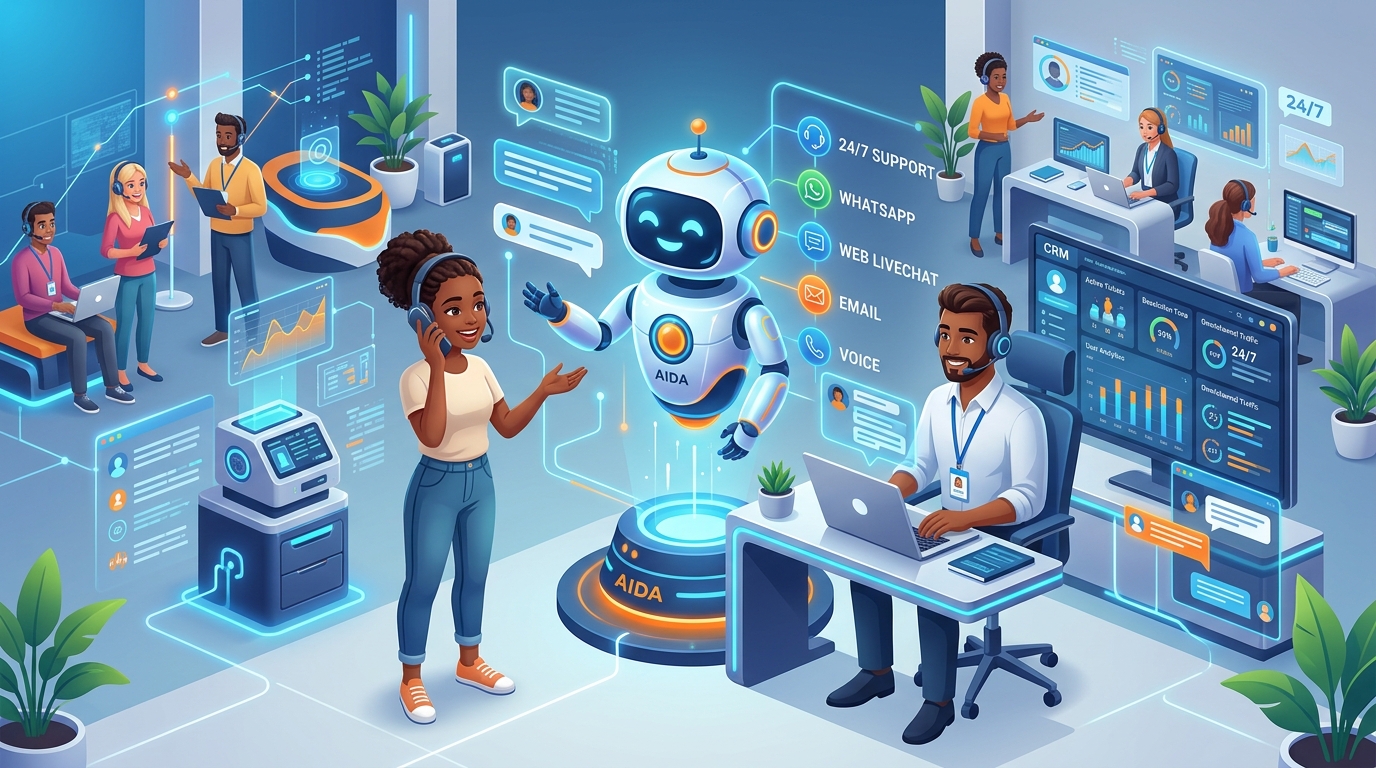
Just think about it: A customer visits your website for a service, perhaps as late as 2 PM. They open the chat to inquire about the service and even send an email but receive no response. Consequently, they immediately turn to your competitor instead.
The reason is that he needs an immediate answer, and I end up losing the customer due to the delayed response. If you check the chat and reply only in the morning, he will simply say "Sorry" and mention that he has already availed the service elsewhere.
This happens every day. You see, customers these days do not have patience and aren't willing to wait long for a message; they want quick and accurate answers.
AI is a great solution for providing 24/7 customer support—it keeps working for you even while you sleep. Whether yours is a growing company or a startup, adopting AI-driven customer service is essential; this is because we need to enhance customer interactions and build trust—which is key to scaling the business to the next level.
In this comprehensive blog, you will find information on the benefits, costs, types, examples, and more of AI customer service, along with other details. After reading this in full, you will easily understand the importance of AI in customer service.
Ok, then we will discuss these points one by one.
What Is AI in Customer Service?
In customer service, AI involves the use of technologies such as virtual assistants, chatbots, Natural Language Processing (NLP), and machine learning to enhance the customer experience by providing immediate responses, answering queries, and offering comprehensive support. AI reduces company costs, saves time, and provides accurate and correct information.
Previously, businesses relied on emails, phone calls, and human intervention to meet customer needs—methods that resulted in wasted time, high costs, and long wait times for customers. To overcome these issues, businesses should leverage AI for customer service. For instance, AI-powered multi-channel customer service can be implemented across platforms such as WhatsApp, Instagram, Facebook, websites, voice assistants, live chat, and more.
Customers can now get immediate answers without wasting time. For example, if a customer visits your website and asks, "How much does your AI in customer service costs?", the AI can instantly respond with your complete pricing details (quotation). Such interactions help convert these customers into 'leads' (potential customers).
How can AI be used in customer service?
In today's digital age, customers expect immediate answers to any questions they raise. In this context, AI (Artificial Intelligence) serves as a valuable asset to businesses. It enhances customer experience by instantly answering queries, resolving common issues, and providing round-the-clock service.
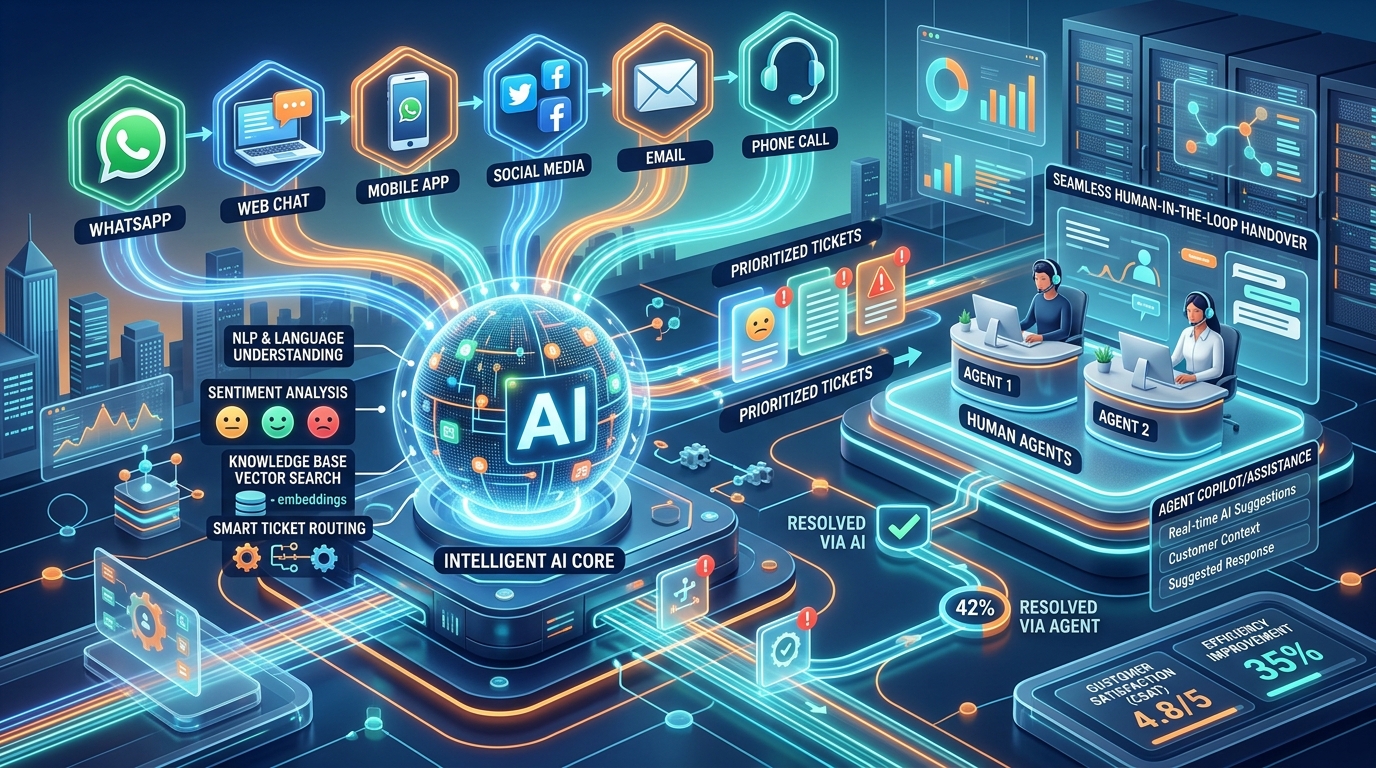
AI is utilized in customer service in various ways such as:
- AI chatbots answer customer queries instantly.
- Virtual assistants simplify tasks such as booking appointments and tracking orders.
- Voice AI responds to calls and connects customers to the appropriate department.
- Automated email support provides quick responses to emails.
- Ticket routing directs customer issues straight to the relevant team.
- Sentiment analysis understands customer emotions and prioritizes urgent issues.
- Personalized recommendations suggest products or services tailored to customer interests.
- 24/7 customer service provides continuous assistance at any time.
Overall, using AI in customer service increases customer satisfaction, reduces operational costs, and enables businesses to provide fast, personalized service. This is a major asset for any business in today's competitive market.
Why is AI important in customer service?
In today's world, AI is a great asset for customer service because it provides instant responses at any time and reduces operational costs for companies.
Simply put, AI transforms customer service from a slow, manual process into a fast and smart system.
Here are the most important benefits for customers are:
- AI chatbots answer customer questions 24 hours a day.
- Customers can get answers to order tracking, password changes, or general questions without having to wait.
- AI understands a customer's past information and provides them with suitable recommendations.
Similarly, some more important benefits for businesses are:
- Since AI handles thousands of routine queries, the need for additional staff is reduced.
- AI tools analyze customer conversations and suggest appropriate responses to staff.
- Businesses can easily manage operations with the help of AI, even when there is a high influx of customers.
What are the 7 Cs of AI in Customer Service?
Customer
AI must first understand the customer's needs. It should provide the right information and assistance that the customer requires.
Convenience
AI should enable customers to easily get help anytime, from anywhere.
Communication
AI should communicate with customers simply and clearly, just like a human.
Customization
AI should provide personalized answers and recommendations tailored to each customer's needs.
Consistency
Customers should receive consistently high-quality service at all times.
Cost Efficiency
You can save time and money by automating repetitive tasks using AI.
Continuous Improvement
AI should learn from past conversations and provide better service day by day.
Popular AI Tools Used for Customer Service in 2026
No single AI tool is suitable for every business. You need to select the right AI tool based on factors such as your business size, budget, the communication channels you use with customers (website, WhatsApp, Instagram, email, etc.), and your specific automation requirements.
Choosing the right AI tool ensures that customers receive faster and superior service. Let us now look at some popular AI customer service tools currently used by successful businesses worldwide.
| AI Tool | Best For | Key Features |
|---|---|---|
| ChatGPT (OpenAI) | Businesses of all sizes | AI chatbot, customer support, content generation, multilingual conversations, API integration |
| Google Gemini | Google Workspace users | AI assistant, Gmail support, Docs integration, customer query handling |
| Microsoft Copilot | Enterprises | Microsoft 365 integration, customer support automation, CRM assistance |
| Intercom Fin AI | SaaS & customer support teams | AI chatbot, live chat, help center automation, ticket deflection |
| Zendesk AI | Large customer support teams | AI ticket routing, automated replies, sentiment analysis, knowledge base |
| Freshdesk AI (Freddy AI) | Small & medium businesses | Smart ticketing, AI chatbot, workflow automation, analytics |
| Salesforce Einstein AI | Enterprise CRM users | AI-powered CRM, predictive insights, customer recommendations |
| HubSpot AI | Marketing & sales teams | AI email assistant, chatbot, CRM automation, lead qualification |
| Drift AI | B2B lead generation | Conversational marketing, chatbot, meeting scheduling, lead qualification |
| Tidio AI | Small businesses & eCommerce | AI live chat, chatbot, visitor engagement, Shopify integration |
| ManyChat | WhatsApp, Instagram & Facebook | Social media automation, lead generation, Messenger and WhatsApp chatbot |
| Zoho SalesIQ (Zia AI) | Zoho users | Live chat, AI chatbot, visitor tracking, CRM integration |
Technical Architecture & Implementation (AI Support Code Example)
For engineering and technical teams, building a custom AI customer support agent involves combining Large Language Models (LLMs) with Retrieval-Augmented Generation (RAG), sentiment scoring, and CRM integrations. Here is the architectural flow and production-ready Python API implementation:

from fastapi import FastAPI, HTTPException
import openai
from typing import Dict, Any

app = FastAPI(title="SaaStargo AI Support Core")

async def handle_customer_query(customer_id: str, message: str) -> Dict[str, Any]:
    """
    Processes incoming customer inquiry using RAG context, sentiment analysis,
    and automatic CRM updates.
    """
    # 1. Analyze customer sentiment & urgency
    sentiment = await analyze_sentiment(message)

    # 2. Retrieve personalized user history and knowledge base chunks (RAG)
    customer_context = await get_customer_crm_history(customer_id)
    knowledge_chunks = await vector_db_search(query=message, top_k=3)

    # 3. Construct augmented prompt for the LLM
    system_prompt = (
        f"You are SaaStargo's AI Support Copilot. Context: {knowledge_chunks}. "
        f"Customer Tier: {customer_context.get('tier', 'Standard')}."
    )

    # 4. Generate AI response with safety guardrails
    ai_response = await openai.ChatCompletion.acreate(
        model="gpt-4o",
        messages=[
            {"role": "system", "content": system_prompt},
            {"role": "user", "content": message}
        ],
        temperature=0.2
    )
    reply = ai_response.choices[0].message.content

    # 5. Automatically log interaction and sync ticket state into CRM
    await update_crm_ticket(customer_id, message, reply, sentiment)

    return {
        "status": "success",
        "reply": reply,
        "sentiment": sentiment,
        "escalate_to_human": sentiment.get("is_frustrated", False)
    }
This enterprise architecture guarantees sub-second response times, eliminates hallucinations by grounding answers on verified business knowledge, and seamlessly escalates frustrated or complex conversations directly to human support staff.
What are the Key Benefits of AI in Customer Service?
Using AI customer service offers several benefits to businesses. In addition to enhancing customer experience, it also reduces time and costs. Some most important key benefits we can explore here:
- 24/7 Customer Service: AI operates around the clock. It provides immediate answers to customer queries—day or night, and even on holidays.
- Instant Response: Customers do not have to wait. AI answers questions within seconds, providing an excellent experience.
- Cost Saving: Since AI automatically handles repetitive tasks, the need to hire additional staff is reduced.
- Improved Customer Satisfaction: Fast and accurate responses boost customer trust and satisfaction.
- Higher Team Productivity: Since AI handles routine queries, staff can dedicate more time to resolving critical and complex issues.
- Personalized Support: AI provides personalized recommendations and answers based on the customer's past information and purchase history.
- More Leads & Sales: Since AI provides instant responses, no lead is missed, thereby increasing sales opportunities.
- Consistent Service Quality: AI delivers the same level of accurate and high-quality service to every customer.
- Multilingual Support: AI can communicate with customers in various languages, enabling businesses to reach a wider audience.
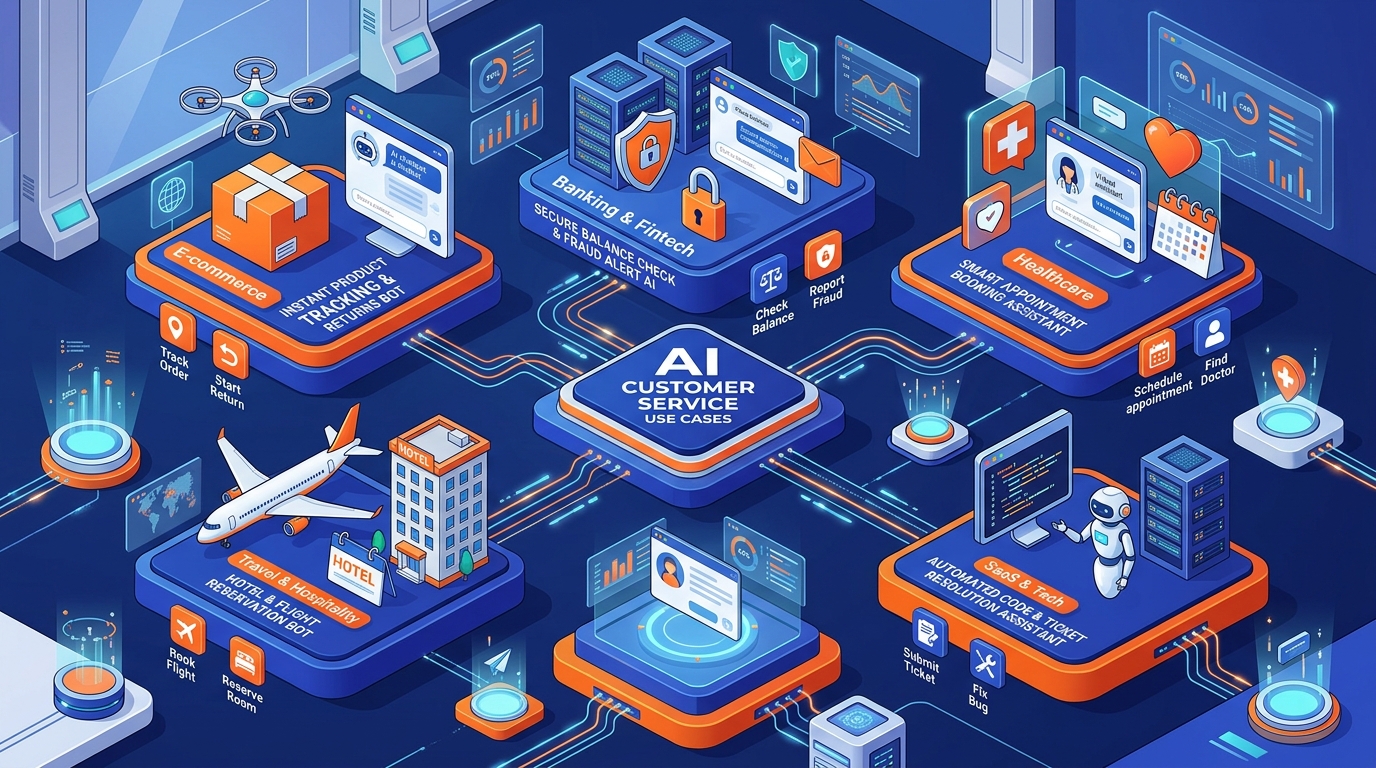
Real-World Use Cases or Examples of AI in Customer Service
Many businesses today use AI for customer service. AI greatly helps in providing fast, easy, and excellent service to customers. Here are some real-world use cases:
What are the Pros and Cons of AI in Customer Service?
AI customer service helps businesses provide faster and better customer service. However, there are also some challenges associated with it.
Pros of AI in Customer Service
- 24/7 Customer Service: AI is always available. Customers can get immediate answers whenever they ask a question.
- Fast Response: Customers do not have to wait. AI provides answers within seconds.
- Saving Time and Money: Since AI handles repetitive tasks, staff time is saved and costs are reduced.
- Can handle more customers: AI can answer the queries of thousands of customers simultaneously.
- Better customer experience: Customer satisfaction increases due to fast and accurate answers.
Cons of AI in Customer Service
- Lack of a human touch: AI can provide correct answers, but it cannot understand emotions the way humans do.
- Limitations with complex problems: Human assistance is still required to solve certain difficult problems.
- Initial cost: Implementing an AI system may require an initial investment of time and money.
- Possibility of incorrect answers: If accurate information is not provided, AI may sometimes give incorrect answers.
- Data security: Handling customer information securely is crucial.
Final Thought
AI customer service is not just a technology today; it is a smart solution that helps businesses grow. AI enables businesses to provide customers with instant, 24/7 responses, personalized service, and an enhanced experience. Additionally, businesses can save time and costs, allowing their teams to focus on more critical tasks.
However, AI will not completely replace humans. For the best results, it is essential to combine AI's speed with a human touch. By implementing the right AI customer service solution, your business can reach more customers, build stronger relationships, and achieve rapid growth.
Does your business need AI Customer Service?
SaaStargo Technologies helps develop AI chatbots, customer support automation, CRM integration, and AI solutions tailored to your business. Transform your customer support with smart AI solutions.
Get a free AI consultation today and take your business to the next level.
AI in Customer Service – Frequently Asked Questions (FAQs)
AI Customer Service is a technology that uses Artificial Intelligence to answer customer queries, resolve issues, and streamline service delivery.
An AI Chatbot provides immediate answers to customer queries, offers information, books appointments, and connects customers to human staff if necessary.
Yes. Small businesses can also use AI to provide 24/7 customer service and deliver great experience at a low cost.
No. AI handles routine and repetitive tasks. Human staff are still needed for complex issues.
Key benefits: Fast response, 24/7 service, Lower cost, Better customer experience, Higher efficiency.
Yes. An AI chatbot can be integrated with WhatsApp, websites, Instagram, Facebook Messenger, and other platforms.
Yes. When integrated with CRM and other systems, AI can provide personalized service by utilizing past conversations, purchase history, and customer preferences.
The cost depends on the size of your business, the level of automation required, the platform used, and integration needs.
AI can be used in various sectors: E-commerce, Healthcare, Banking, Education, Real Estate, Travel, Restaurants, IT and Software.
First, identify the common questions asked by your customers. Then, select the right AI tool and integrate it with your website, WhatsApp, or CRM.
Most AI tools support multiple languages. They can communicate with customers in various languages, including Kannada and Hindi, alongside English.
By using the right AI tools and security measures, customer information can be handled securely.
Yes. AI provides immediate responses, understands customer needs, and helps forward high-quality leads to the sales team.
AI is useful for any business that receives a high volume of customer inquiries. It is particularly beneficial for e-commerce, services, healthcare, education, and SaaS companies.
If your business receives customer inquiries daily, AI customer service is an excellent solution for providing quick responses and delivering high-quality service.